
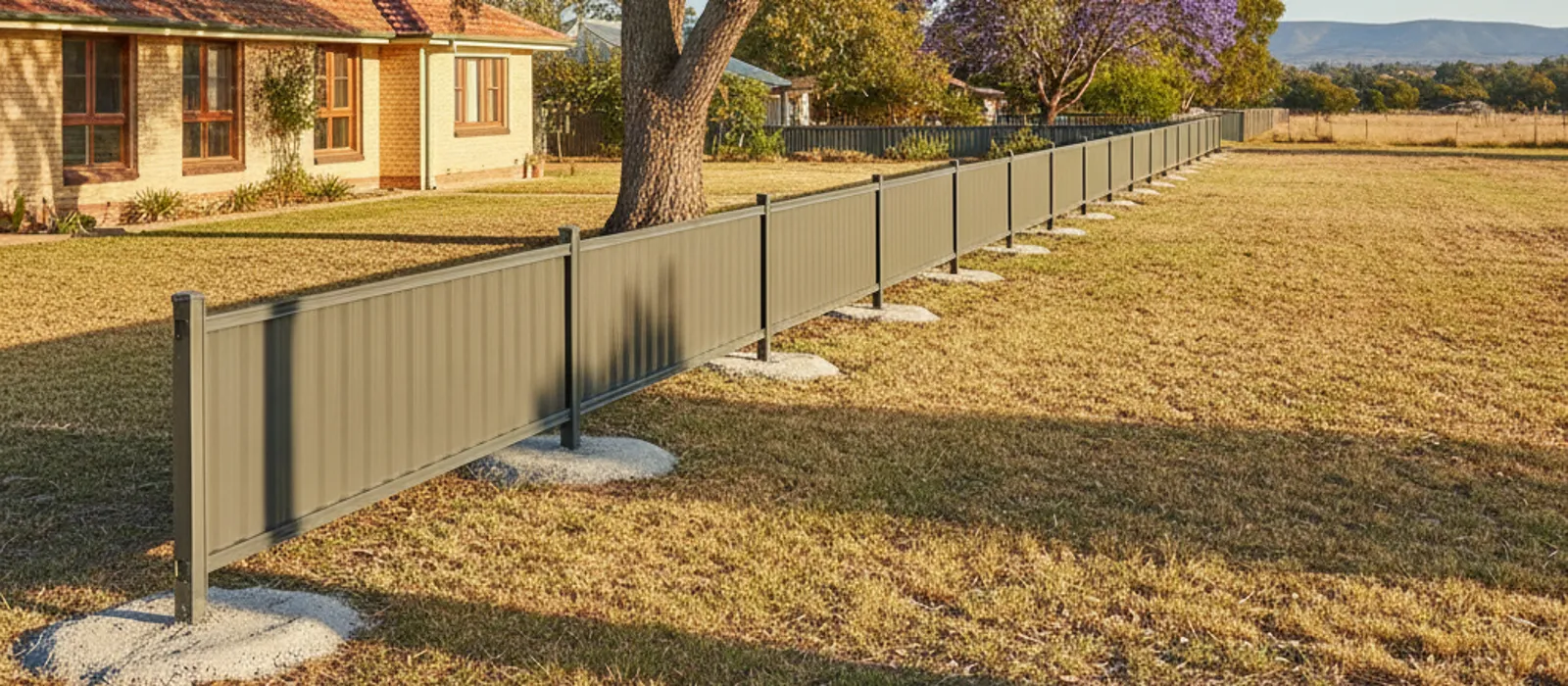
You have a quote for a new side fence, your neighbour has said “fine, send me half”, and then the fence contractor asks a question nobody can answer: where exactly does the fence go? Under the Fences Act 1975 (SA), that question isn’t a detail. It decides who owes what, and whether the notice you serve holds up.
This guide walks through how the fences act in SA works in practice: the notices, the 30-day window, the cost split, and the point where a boundary survey stops being optional. It’s general information, not legal advice. For a live dispute, a conveyancer, a lawyer or the Legal Services Commission is the right next call.
If you already know the fence line is contested, you can tell us what the survey is for and get a written quote from an independent Licensed Surveyor. We put you in touch with the surveyor, who quotes and contracts with you directly.
What the Fences Act in SA actually covers
The Act sets out how neighbours share the cost of a dividing fence and what happens when they can’t agree. It doesn’t make your neighbour pay for anything by default. Nobody has to contribute to a fence unless both owners agreed, the proper notices were given, or a court orders it.
The Act works through three forms. A Form 1 notice is for a new fence. A Form 2 notice is for repairing or replacing an existing one. A Form 3 is the cross-notice a neighbour can serve in reply. Each is a written notice, and the details you put in it matter.
A Form 1 notice states the length and position of the fence, the type, a cost estimate, the share you’re asking your neighbour to pay, any compensation for encroachment, and the contractor. That “position” line is where a surveyor comes in. If the notice describes a position that turns out to be wrong, you’ve built a dispute into the paperwork.
The fencing notice in SA and the 30-day clock
Once your neighbour receives the notice, they have 30 days to serve a cross-notice. They don’t need to give a reason. If they do nothing in that time, they are taken to have agreed. If they serve a cross-notice, the work doesn’t start on your terms: you either reach agreement or go to court.
You can start work after the 30 days if no cross-notice arrives, or after the two of you agree, or after a court decision. Starting earlier than that, without agreement, is where people get into trouble when they later try to recover the cost.
Get the notice right the first time. A vague position, or a line guessed from the existing fence, gives your neighbour a fair reason to object.
The SA Government’s boundaries and fences page is a good starting point for the process and the forms themselves.
Who pays for a boundary fence in SA, and the survey
Where there’s no agreement, the neighbour’s share of an adequate fence is one-half of the minimum cost of erecting an adequate fence. The Act presumes equal benefit. “Minimum cost of an adequate fence” is the key phrase: if you choose a more expensive fence, the difference is yours unless your neighbour agrees to it.
The Act also treats the cost of any survey reasonably required for the fencing work as a fencing cost (section 4). That matters for a Form 1 notice, because the survey can sit inside the shared cost when it’s genuinely needed to place the fence.
The Legal Services Commission puts the other side plainly in its Fences and the Law booklet (December 2023). If you both want the survey, you can agree to share the cost. If not, the person who arranges the survey pays for it. So the order of events matters: talk to your neighbour before you engage a surveyor, not after.
| Item | What the Act or the official guidance says | Practical point |
|---|---|---|
| Neighbour’s share of an adequate fence | One-half of the minimum cost of erecting an adequate fence | Upgrades above “adequate” are yours unless agreed |
| Survey reasonably required for the fencing work | Counts as a fencing cost under s 4 | Put it in the Form 1 notice if you need it |
| Survey one owner wants alone | The person who arranges it pays, unless both agree to share (Legal Services Commission) | Ask your neighbour before you book |
| Neighbour ignores the notice | Deemed agreement after 30 days with no cross-notice | Only if the notice was served properly |
| Disagreement that won’t settle | Magistrates Court (minor civil), lodged online through CourtSA | A survey is the evidence the court can use |
| Council approval | Masonry fences over 1 m, other fences over 2 m, fences over 1 m within 6 m of a road intersection, and brush fences | Check before you order materials |
Surveyors quote each job. The price depends on the block, the evidence on site and the survey type. Adelaide firms don’t publish prices for boundary surveys, so any figure you see online is a guide at best. One national cost guide, Trade Heroes (updated 6 March 2026, GST not stated), gives a range of $900 to $2,500 for a boundary survey across Australia. That’s a national range, not an Adelaide price. A surveyor quotes your block.
Where the boundary is: why the fence is not the answer
Most people assume the existing fence marks the boundary. Often it does, roughly. Sometimes it doesn’t, and the gap can be larger than either owner expects. The Surveyors Board SA says major discrepancies between boundaries and fencing aren’t uncommon and can sometimes be very difficult to rectify.
In South Australia, only licensed surveyors can undertake a boundary survey or place a survey mark that defines a property boundary. That’s the law under the Survey Act 1992 (SA), and the Surveyors Board SA states it directly. A tape measure from the neighbour’s shed, a site plan from a sales brochure or a real estate map doesn’t give you a legally defensible line. Surveys by unlicensed practitioners have no legal standing.
That means two things for you. First, if a fence dispute turns on the position of the boundary, the person who can settle it is a Licensed Surveyor. Second, check any surveyor’s licence before you engage them. There’s no searchable online register. You contact the Registrar at the Institution of Surveyors SA Division, or check the Gazette list of licensed and registered surveyors, which is updated each July and January.
Our boundary surveys page explains what the survey involves and what it produces. If the pegs on your block have vanished, survey pegs missing covers what to do first.
Three situations on Adelaide blocks
These are composites, not case files. They show how the Act and a survey interact. The outcome in each depends on the title, the evidence on site and what a Licensed Surveyor finds.
A leaning Colorbond fence in Salisbury. The fence has leaned for years and both neighbours are sure it sits on their side. One wants to replace it and serves a Form 2 notice. The other serves a cross-notice within 30 days, saying the fence isn’t where the notice claims. Neither can prove a position, so the exchange stalls. A boundary survey settles the factual question, and because a survey reasonably required for the fencing work counts as a fencing cost, it can be part of the discussion. It doesn’t decide who pays for the replacement; that follows the Act’s rules, or a court.
A fence agreed off the line on a Mount Barker corner block. Two owners agree, years ago, to build the fence a little inside one block to avoid a tree root. One of them later sells. The buyer’s conveyancer asks whether the fence matches the title. It doesn’t, and the new owner wonders whether the old fence position has given the neighbour any claim. Under s 17 of the Act, a fence built off the line by agreement doesn’t give either owner title by adverse possession. The agreement still needs to be understood and, ideally, written down. That’s a conveyancer’s job. A survey shows the gap, and a lawyer or conveyancer advises on what to do about it.
A bluestone villa in Unley with a side wall on the boundary. The owner wants a new fence running out from the front corner of the wall. The wall is old and the title shows the boundary running along or near it, but old walls aren’t always precise. Before serving a notice, they want to know where the fence should start. A Licensed Surveyor can determine the boundary and mark it, and the fence position in the Form 1 notice can then rest on that. If the survey reveals that part of a structure crosses the line, the Encroachments Act 1944 (section 4) lets either owner apply to the Land and Valuation Court, and a conveyancer or lawyer should be involved before anyone acts.
When a survey is worth it, and when it is not
A survey isn’t always necessary. If your neighbour agrees to the fence, agrees to the cost, and you both accept the existing line, you can proceed without one.
A survey is worth serious thought when any of these apply:
- Either of you disputes where the boundary is.
- The existing fence is visibly off, or the neighbour has said it is.
- You’re building something against the fence, such as a retaining wall or a shed, where an error costs far more than the fence.
- You’re buying or selling and want to know that the fences and structures sit within the title.
- The pegs are missing and nobody can say where the corners were.
The Legal Services Commission notes that a court is unlikely to order a fence relocated if it is only slightly off the boundary. That cuts both ways. A survey can tell you the deviation is small enough to live with, which is useful information before you spend money on court. Or it can show a larger gap, in which case the Magistrates Court can decide the line of fence to be adopted and order removal of a fence not erected on the proper boundary.
Which survey you need depends on the question. If the dispute is about the line itself, a boundary survey is the usual route. If you are buying and only want to confirm that structures sit inside the title, an identification survey is the more common request. Note that the pegs on an identification survey represent the surveyor’s opinion as to the boundary position and aren’t a fresh definition of it. The result is recorded publicly as a Plan for Information Purposes.
For how a survey is used as evidence, see boundary fence dispute survey SA. To know what a quote should include, use the land survey quote checklist.
If you’re not sure which survey fits your situation, that’s a normal place to start. Use the contact form to describe the fence, the block and what you need, or call now on (08) 5550 3814. The form comes first. We pass your details to an independent Licensed Surveyor who quotes and contracts with you directly.
A sensible order of events
- Talk to your neighbour first. Most fence disputes are about surprise, not money.
- If the line is in question, agree on a survey and how to split its cost before anyone books one.
- Engage a Licensed Surveyor and check the licence with the Institution of Surveyors SA Division.
- Serve the correct notice (Form 1 for new, Form 2 for repair or replacement), using the survey result for the position.
- Wait out the 30 days, then check whether council approval applies before work starts.
Skipping step 2 is what turns an ordinary fence into a long argument.
Frequently Asked Questions
Does my neighbour have to pay half for a new boundary fence in SA?
Not automatically. Nobody has to contribute unless both owners agreed, the proper notices were given, or a court orders it. Once a valid notice is served and no cross-notice comes within 30 days, agreement is presumed. Where the share is decided, it is one-half of the minimum cost of an adequate fence.
Who pays for a boundary survey when we disagree about the fence line?
If you both want the survey, you can agree to share the cost. If not, the Legal Services Commission says the person who arranges it pays. The Act also treats the cost of a survey reasonably required for the fencing work as a fencing cost. Talk to your neighbour before booking, and get advice if the amount is significant.
Can I use a tape measure or a site plan to work out where the boundary is?
Not for anything you plan to rely on. In South Australia, only licensed surveyors can undertake a boundary survey or place a survey mark that defines a property boundary. A measurement from an old fence, a title diagram or a sales plan is a starting point, not a boundary. A Licensed Surveyor quotes the job after seeing the title and the block.
What happens if my neighbour ignores the fencing notice?
If they serve no cross-notice within 30 days, they’re taken to have agreed and you can start the work. That only holds if the notice was served properly and includes the required details. If the notice was flawed or the line is disputed, the Magistrates Court can decide the line of fence and the cost. A conveyancer or lawyer can advise on your specific situation.