
You can tape the block, read the title and pull up an aerial photo, and still not know where your boundary is. That gap is how fences end up on the wrong line and sheds end up on someone else’s land. This guide explains how to find property boundaries in South Australia: what you can check yourself, where the paperwork stops helping, and when only a Licensed Surveyor can settle it.
Torrens Survey Co is an advertising service, not a surveying firm. It holds no surveying licence and doesn’t survey, peg or lodge anything. If you need a boundary located, we put you in touch with an independent Licensed Surveyor, who quotes and contracts with you directly. Tell us what the survey is for using the contact form and you can get a written quote, or call (08) 5550 3814 if you’d rather talk it through.
Why the Fence, the Map and Your Memory Do Not Settle It
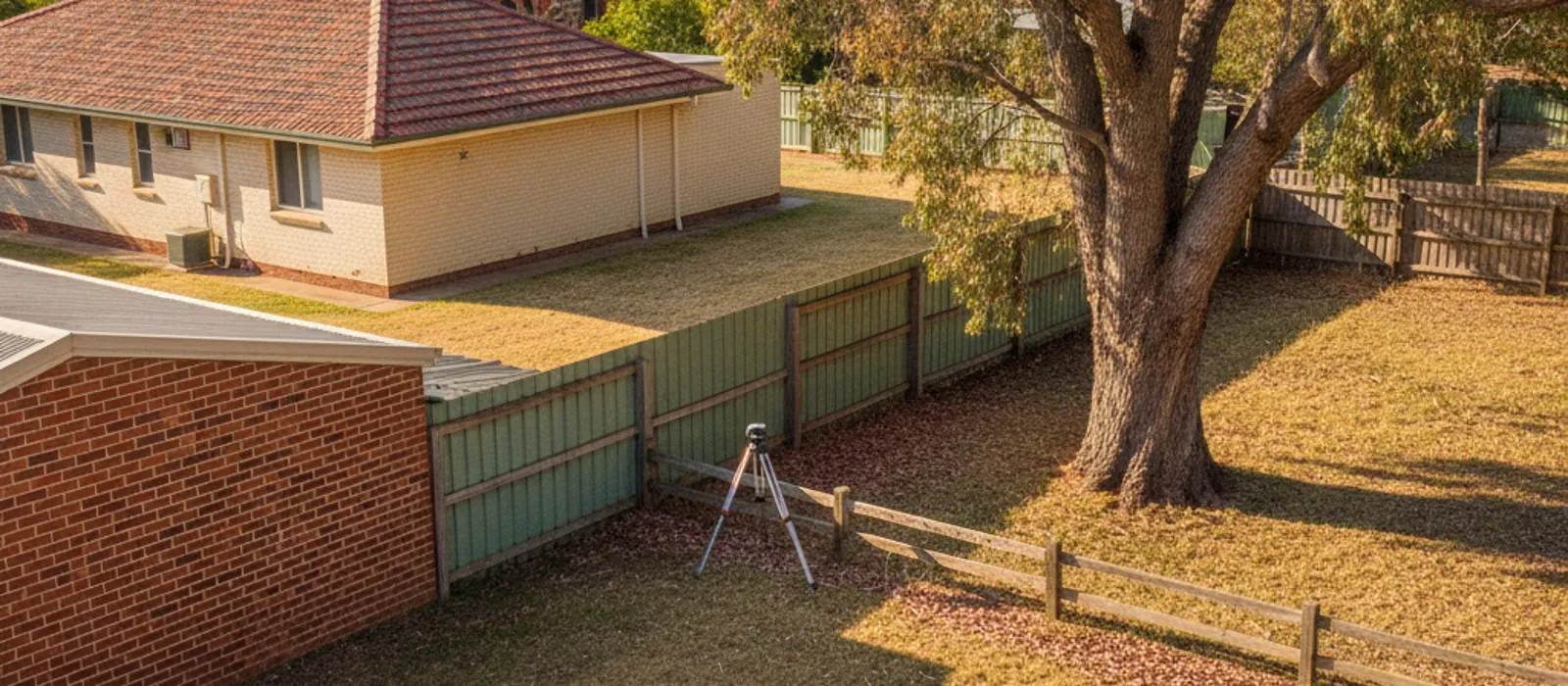
Most owners start with the fence. It’s right there, it looks straight, and the previous owner said it was the line. The trouble is that a fence is only where somebody once built it.
The Surveyors Board SA says plainly that “major discrepancies between boundaries and fencing are not uncommon and can sometimes be very difficult to rectify.” Fences get built off the line by agreement, by mistake or because the ground was easier that way.
Online property maps and aerial images have the same limit. They’re handy for a first look at the shape of your block, but they’re not a survey. SA Government advice is that a property boundary defines legal ownership of land and its position can only be determined by a licensed surveyor.
That’s the core rule for everything below. You can gather clues yourself. Only a survey by a Licensed Surveyor gives you a boundary you can rely on when there is money or a neighbour involved.
How to Find Your Property Boundaries: Start With the Paperwork
Before anyone comes on site, get the documents. They cost little, and they tell you what question to ask the surveyor.
Your certificate of title. It’s the registered record of who owns the land and what is registered against it, such as a mortgage or an easement. Your conveyancer will have a copy from your purchase, and a conveyancer or solicitor can get a current one. There is more on this in our guide to the certificate of title in South Australia.
The plan behind the title. The title refers to a registered plan showing the shape of the allotment, its side lengths and angles, and any easements. Read the plan next to the title, not instead of it.
What can you do with these? Measure your own fences and buildings and compare them to the plan. If the numbers roughly agree, that’s a good sign but not proof. If the frontage on the plan is one width and your fences show another, you have found your question. That’s worth knowing before you build, buy or sign a fencing notice.
What you can’t do is convert a plan into a position on the ground by eye. Turning a drawn plan into a marked point needs measurement from established survey marks, and weighing up old fences, walls and marks against the record is a professional judgement. That’s why the law reserves it.
Finding Property Boundary Pegs and What They Really Mean
The next clue is a peg. Surveyors place marks at boundary corners, and finding one can feel like finding the answer. Sometimes it’s a useful clue. It’s never the end of the story.
Marks go missing all the time. Paving, retaining walls, new fences and years of gardening bury or destroy them. If you find something small and metal near where a corner should be, you usually can’t tell who put it there, when, or what it was for. It might be a survey mark, a builder’s peg or something left from an old fence.
Even a genuine peg carries a qualification. The Surveyor-General’s guidelines describe pegs placed on identification surveys as representing the surveyor’s opinion as to the position of the boundary, subject to any errors of survey or judgement.
Two rules matter here:
- If you find a peg, leave it exactly where it is. SA Government states that by law you can’t move or remove a survey mark made by a licensed surveyor, and doing so can bring legal action and fines.
- Permanent survey marks (PSMs) are a different thing. They “do not mark the boundary corner”, they are shown on plans with references to the corner, and disturbing one without the Surveyor-General’s approval can bring fines of up to $2,000 per PSM.
If your pegs are gone, the fix is a Licensed Surveyor re-establishing them. Our page on missing survey pegs explains what that looks like, and the identification surveys page covers the survey type that does it.
Every Way to Find Your Property Boundary, Compared
Here’s how the usual methods stack up. The column that matters most is the third.
| Method | What it tells you | Does it define the legal boundary? | Best used for |
|---|---|---|---|
| Existing fence | Where someone built a fence | No. It shows where a fence is, not where the boundary is | A starting clue only |
| Certificate of title and registered plan | Allotment shape, dimensions, easements, registered interests | No. It describes the boundary but does not place it on the ground | Preparing questions, checking easements |
| Online maps and aerial photos | The rough shape of the block and neighbours | No. Not a survey | A first look before you ring anyone |
| Pegs you find on site | A possible past survey mark | Not reliably. You can’t tell who placed it or whether it still holds | A clue to show the surveyor |
| Survey by a Licensed Surveyor | The boundary located and marked on the ground, with a record | Yes. Only licensed surveyors can place a survey mark that defines a boundary in South Australia | Disputes, building near the line, buying, missing pegs |
On cost: Adelaide survey firms don’t publish prices for boundary work. Surveyors quote each job, and the price depends on the block, the evidence on site and the type of survey. For a national reference point only, Trade Heroes’ cost guide (updated 6 March 2026) lists a boundary survey at $900 to $2,500. That’s a national figure, not an Adelaide price, so an Adelaide surveyor has to quote your block.
Three Situations Where Finding the Boundary Decides the Outcome
These are anonymised, typical scenarios. They’re not customer stories, and the outcomes depend on what a survey actually finds.
A leaning Colorbond fence in Salisbury
Two neighbours share a Colorbond fence that has been leaning for years. Each is sure it sits on their side. One wants to replace it and split the cost, and the other says the whole thing is already over the line.
Under the Fences Act 1975 (SA), the cost of any survey reasonably required for the fencing work counts as a fencing cost. The replacing owner serves a notice, and the neighbour has 30 days to serve a cross-notice. If the two of them can’t agree on the line, the Legal Services Commission advises getting a survey that shows the precise location of the boundary. If both want it they can share the cost, but if not, the person who arranges it pays.
The Magistrates Court can decide the line of fence to be adopted, but the Commission notes a court is unlikely to order a fence moved if it deviates only slightly from the boundary. So a survey is often the cheapest way to find out whether you have a real problem or a small one. Our guide to boundary fence disputes and surveys walks through the steps.
A bluestone villa in Unley with a wall on the title line
The side wall of an old bluestone villa runs right up to the neighbour’s side. The owners want to add a rear extension and the designer needs boundary offsets for the site plan. Nobody actually knows whether the wall sits exactly on the boundary, slightly inside it or slightly over.
SA Government defines an encroachment as a structure that crosses the legal boundary, and says it can include buildings, driveways, eaves and balconies. Encroachment disputes go to the Supreme Court, and under the Encroachments Act 1944 either owner can apply to the Land and Valuation Court. Those are matters for a lawyer, not a surveyor.
What the survey does is fix the facts: where the line runs, and where the wall, eaves and gutters sit against it. A development application site plan must show the boundaries and dimensions of the site and setbacks to boundaries. A feature and level survey is the usual way to get the existing levels and boundary offsets, and the boundary itself comes from a Licensed Surveyor. The Surveyors Board advises engaging one when building on or near a land boundary. Read more about how this works on our boundary surveys page.
A Mount Barker buyer checking the shed
A buyer is under contract on a house in Mount Barker, one of the growth areas in the Adelaide Hills. The seller’s shed sits near the back fence, and the title shows an easement along one side. The buyer wants to know two things before settlement: is the shed inside the title, and is any part of it over the easement?
The Surveyors Board recommends a Licensed Surveyor when buying or selling so you know about any encroachments. An identification survey marks the boundary and shows the shed’s position against it, and the easement is located from the registered plan. Our guide on identification surveys before buying covers when it is worth doing.
Settlement dates don’t wait. Ask the surveyor upfront how long they need, because we can’t promise a turnaround. Whether a structure can stay on an easement is a legal question for your conveyancer or solicitor, not something a survey answers.
If one of these sounds like your block, tell us what the survey is for and we will pass it to an independent Licensed Surveyor who can quote it in writing.
Who Can Legally Locate Your Boundary in South Australia
In South Australia, only licensed surveyors can undertake a boundary survey or place a survey mark that defines a property boundary. That’s the Surveyors Board’s wording, and it matches the Survey Act 1992 (ss 14 and 15). The Board also says surveys done by unlicensed people have no legal standing.
Licensed Surveyors and Registered Surveyors aren’t the same. Licensed Surveyors have expertise in identifying and measuring property boundaries. Registered Surveyors work in other areas, such as engineering, mining and hydrography. For a boundary job you want a Licensed Surveyor. Our guide to licensed and registered surveyors sets out the difference.
You can and should check. There’s no searchable online register. Instead, contact the Registrar at registrar@isasa.org.au or on (08) 8212 0343, or read the Government Gazette list of Licensed and Registered Surveyors in South Australia, updated each July and January. Details are on the Surveyors Board SA public information page.
Before you accept a quote, ask these questions:
- Is the person doing or supervising the survey on the current licensed list?
- What is the survey for, and does the quote match that purpose?
- Does the quote include marking the corners, and what will I receive at the end?
- What could change the price once they see the site?
Get Your Boundary Located Without Guessing
The honest first step is working out what kind of survey you need. A fence dispute, a building plan and a purchase are three different jobs, and a good surveyor will tell you which one fits.
Use the contact form to say what the survey is for, and we will put you in touch with an independent Licensed Surveyor who quotes and contracts with you directly. If you prefer to talk, you can call (08) 5550 3814. The SA Government boundaries and fences page is a good neutral read while you wait.
Frequently Asked Questions
Can I find my property boundaries myself?
You can gather clues yourself: read your certificate of title and plan, measure your fences and buildings against them, and look for existing pegs. That will show you whether there’s a question worth asking. It won’t give you a legal boundary, because in South Australia only a Licensed Surveyor can determine and mark one.
Does my fence show where the boundary is?
Not necessarily. A fence shows where someone built a fence. The Surveyors Board notes that major discrepancies between boundaries and fencing are not uncommon. A survey is the only way to know whether your fence sits on, inside or over the line.
How much does it cost to have a boundary located in Adelaide?
Adelaide firms don’t publish prices for boundary work. Surveyors quote each job, based on the block, the evidence on site and the survey type. National guides, such as Trade Heroes at $900 to $2,500 for a boundary survey, are not Adelaide prices, so ask for a written quote for your block.
Can I move or remove a boundary peg I find?
No. SA Government states that by law you can’t move or remove a survey mark made by a licensed surveyor, and doing so can result in legal action and fines. If a peg looks damaged, or you think it’s in the wrong place, leave it and ask a Licensed Surveyor to look at it.